Ireland-England at Malahide: Contrasting Scheduling Crises

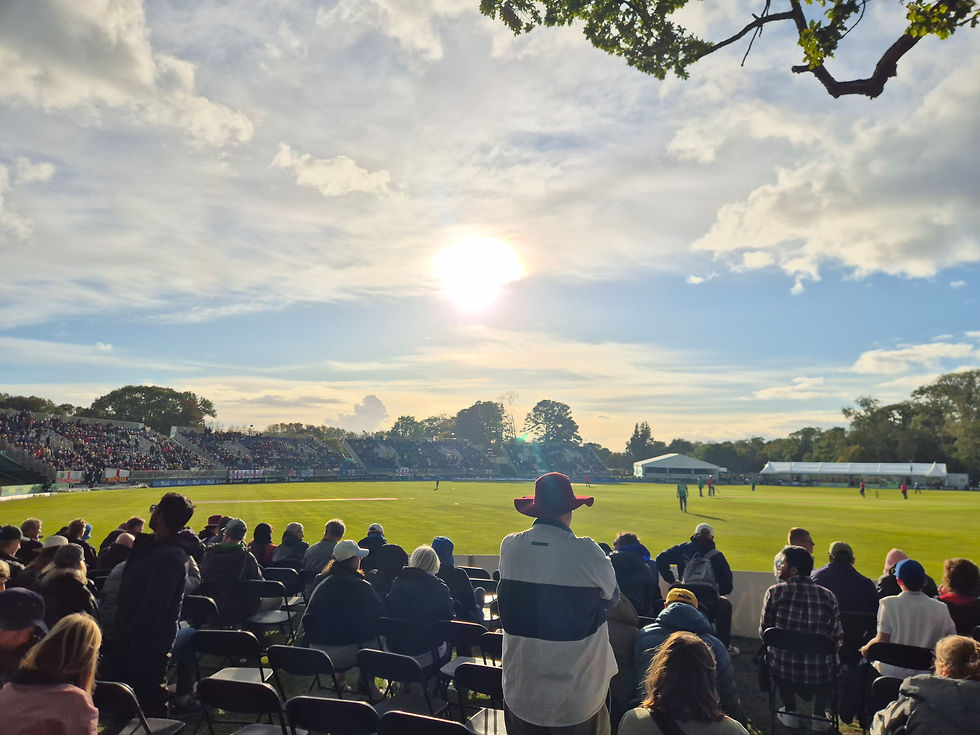
Perhaps it’s the onset of autumn; the sun hanging low over the top of the temporary stands and shadows lengthening earlier than they did just a few short weeks ago at the height of summer, the first hint of brown on the leaves of the stately trees that surround the ground. Or, perhaps, it’s the fatigue of the England players marching onto the field one last time after a madcap summer of international fixtures; or the frustration of the Irish team playing the last of a much more limited number of games, made all the more galling by this one having been switched from an ODI to a T20I and shoved ungraciously to the back end of September. Whatever the cause, there’s a lethargy that pervades sportsmen and spectators gathered at Malahide for this third and final twenty-over clash – not that one could really call it that – between England and Ireland.
A sense of dreary inevitability sets in from the early stages. Ireland post an acceptable, but non-threatening total of 155. Rain clouds emerge in the distance early on in their innings and march unrelentingly towards Malahide through the last ten overs. For a moment there seems to be hope that we will be spared the worst of the weather as the ground appears to be in the eye of a storm, rain visibly falling all around in the near distance but not on the field itself. Alas, that hope is soon crushed as the heavens open and send down the kind of misery-inducing drizzle that can’t truly be classified as rain, but which soaks you to the skin nonetheless. An elongated innings break ensues before, with blue skies emerging, England’s formidable batting line-up makes short work of that modest total, taking the game, and the series, with 2.5 overs to spare.
The heavily English, sell-out crowd marches back to Dublin or to Malahide’s pubs with a distinct lack of cheer. This is completely understandable. What they saw felt very much like a non-event. It came across as two groups of men begrudgingly meeting an obligation, a formality imposed on them by the powers that be in which they had no choice but to participate. This atmosphere is not the product of the changing of the seasons, but of a subject which, in recent years, has drawn outcry from players and eye rolls from spectators: scheduling.
For England, this was the 32nd match played across all formats, as well as four countries and two continents,

since January 2025. They were scheduled to be in New Zealand less than a month later for six limited overs fixtures, which would be followed, barely three weeks further on, by the first of five Ashes Tests. The last of those Tests could finish on January 8th, 2026, a mere 14 days before the start of a three ODI, three T20I series against Sri Lanka in preparation for the T20 World Cup to be held there, and in India, from February 7th. Several key England players are all-format, and many of them also have IPL, Hundred, and (sadly limited) county commitments to honour also. Putting aside any debate about whether one should sympathise with well-paid sportspeople with prodigious amounts of air miles, it’s clear that such an unrelenting travel and playing schedule is hardly conducive to sustained, high-standard athletic performance. It’s little wonder, then, that the England side which turns out at Malahide is lacking several major players, including its captain (replaced for the series by Jacob Bethell, who therefore became the youngest-ever man to captain an England cricket team). Those who had campaigned throughout the summer appeared fatigued, running low on steam after a gruelling playing itinerary and presumably looking forward to a rest, perhaps three weeks at most, before boarding yet another plane for yet another series.
For all the talk of the game’s decline, we seem, at least with England’s national side, to have hit peak cricket. This begs the question of whether that supposed decline is, in fact, a product of quantity being favoured over quality. On the strength of the showing at this final match against Ireland, one is forced to take the view that having so many opportunities to attend England matches does seem to diminish the on-field product. A better balance needs to be struck. Each summer, it seems a revolving cast of touring sides arrives for contextless limited-overs series that are designed not to entertain but to satisfy the demand of smaller international club grounds (like those of Glamorgan, Gloucestershire, and Durham) for vital, revenue-generating sell-outs. But if spectators are forced to watch a group of worn-down players behaving like automatons, going through the motions of cricket without passion or commitment, is this a sustainable model? Could the ECB not make better use of its sizable income, and the influx of funding from the sale of stakes in Hundred franchises, to trial a different model where fewer clubs are given England fixtures annually but can rest assured that, when they are given matches, they will be of a higher quality and more likely to sell out thanks to their scarcity? Could Tests be divided more equitably between the larger and smaller international grounds, giving at least one of those smaller clubs much-needed, multi-day sell-out revenue each season? Do Lord’s and The Oval, both owned by clubs in rude financial health, really need both Test and limited overs matches every summer?
By contrast, one nation that need not worry about an oversaturation of cricket is Ireland. This third T20I was only Ireland’s 16th international fixture in 2025, and one of only nine limited overs matches (and no Tests) they were scheduled to play at home in the season. Four of those home ties ended in no result or were abandoned without a ball being bowled. After England’s departure, two cricket-less month’s would follow before a two-Test, three-T20I series away against Bangladesh in November. Financial challenges arising from the need to build temporary stands and other event infrastructure at club grounds like Malahide and Clontarf have led to multiple cancelled tours, including visits by Australia in 2024 and Afghanistan in 2025. The problem with this dearth of international fixtures is compounded by the fact that, having become a full ICC member in 2019, Ireland lost the ability for players to join English county sides without counting towards their cap on overseas players. Coupled with a mooted European T20 league in which Irish sides would participate consistently failing to get off the ground, as well as a lack of high-level First Class and List A domestic opportunities, this has led to a situation where the majority of Irish players do not get regular exposure to top level professional competition. As a result, in contrast to their English counterparts, Ireland’s star players have publicly expressed discontent at the lack of cricket in their calendars.
There are some clear possible remedies to this situation that would also serve to bolster the sustainability of Cricket Ireland and other full member boards who suffer from a lack of funding. Firstly rules around Irish players counting towards overseas caps could be relaxed, in light of the lack of domestic opportunities in their home country, to allow more of them into the County Championship and English limited overs competitions. This should serve to develop and strengthen the national side. Secondly, the ICC could overhaul the distribution of funds amongst full members. Currently, India receives almost 40%, over $200m, of all funding. Newer and smaller full members, including Ireland, receive between 2% and 5%. A more equitable sharing of central funds would support delivery of Cricket Ireland’s plan to build a permanent stadium on the outskirts of Dublin, provide the necessary cash to pay for temporary stadium infrastructure in the meantime, and permit much needed investment into the domestic game for both men and women. Were these measures to be implemented, it might not be long before Irish players are also complaining about the amount of cricket in their calendars.


Comments